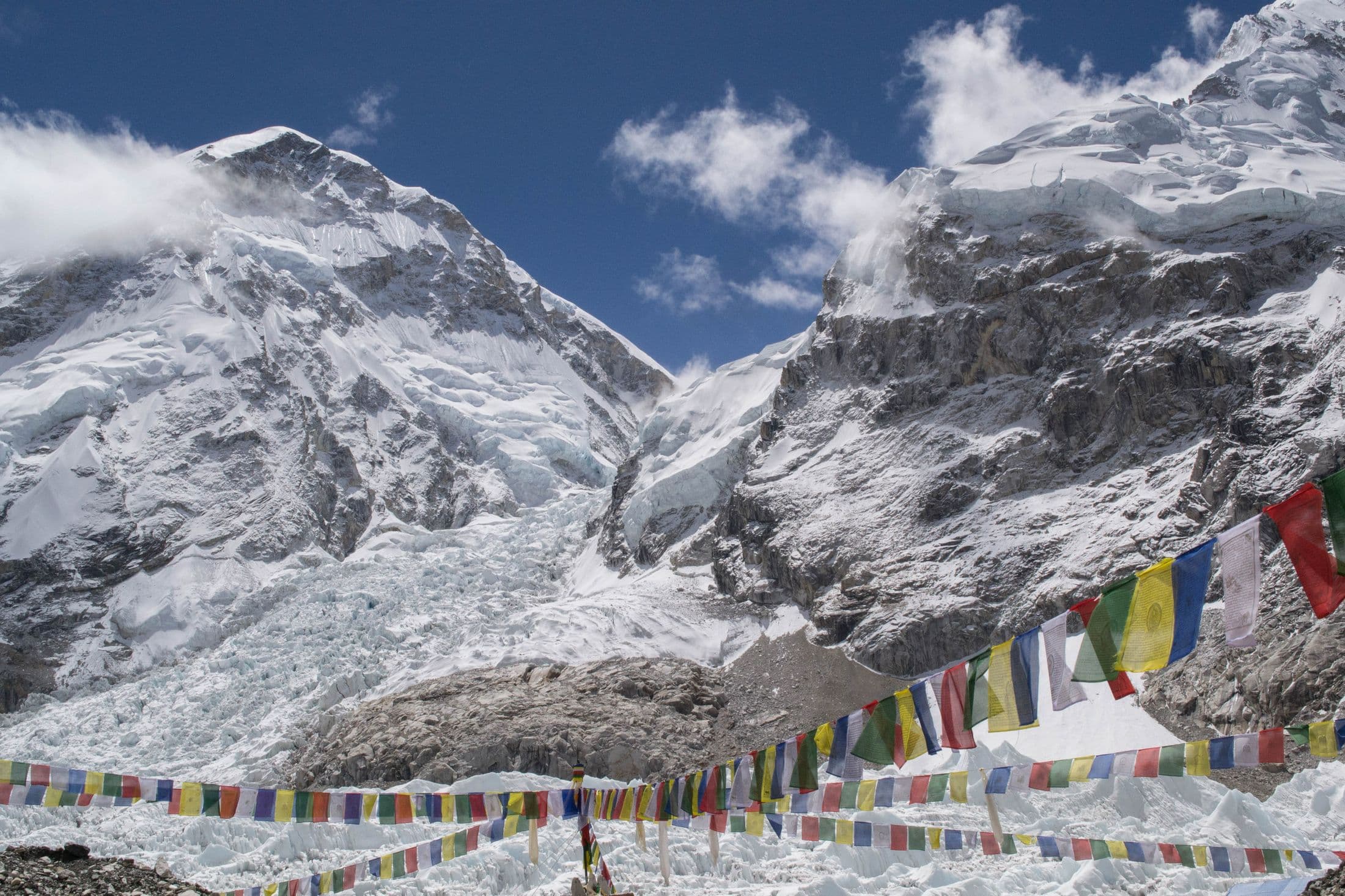
Prayer flags at Everest Base Camp with the Khumbu Icefall behind

Explore Everest

Everest Base Camp Trek

The classic route into the Khumbu — Lukla to Base Camp and back, with a side trip up Kala Patthar for the view Base Camp itself doesn't give you.

Fact-checked 25 August 2026

Published duration
14 Days
Difficulty
Moderate–Hard
From / person
$1,450 USD

The route

From Lukla the trail follows the Dudh Koshi river up through Phakding and Namche Bazaar, climbs through Tengboche and Dingboche to Lobuche, and finishes at Everest Base Camp (5,364m) beneath the Khumbu Icefall. Most groups climb Kala Patthar (5,545m) the following morning for the clearest view of Everest's summit on the whole trek — Base Camp itself sits too close under the mountain to see the peak.

It's a long walk, not a climb: no ropes, no technical sections. What makes it hard is the altitude and the number of days spent above 4,000m, not the terrain underfoot.

Duration and difficulty

Fourteen days is the standard length for a reason — it builds in two proper acclimatization days (Namche and Dingboche) rather than rushing straight up. Shorter itineraries exist, but they trade away exactly the days that keep altitude sickness manageable. Expect five to seven hours of walking on a typical day, more on the Base Camp and Kala Patthar days.

Plan the trek

Everest Base Camp trek at a glance

The standard journey is a non-technical, high-altitude teahouse trek. The walking is demanding because of repeated days above 4,000 metres, not because ropes or climbing skills are required.

Typical plan
12 trekking days plus weather buffer
Highest destination
Everest Base Camp, about 5,364 m
Common viewpoint
Kala Patthar, above 5,500 m
Highest overnight
Gorak Shep, about 5,164 m
Accommodation
Teahouses along the route
Primary challenge
Altitude, cold, and sustained walking

Day by day

A paced 14-day Everest Base Camp itinerary

This planning model protects the acclimatization days at Namche and Dingboche and leaves time for a disrupted Lukla flight. Exact walking times, overnight villages, and flight routing must be confirmed for each departure.

DayRouteSleepAltitudeWhy it matters
1Fly to Lukla; walk to PhakdingPhakding2,610 mA deliberately short first walking day.
2Phakding to Namche BazaarNamche Bazaar3,440 mThe first major sleeping-altitude gain.
3Acclimatization day in NamcheNamche Bazaar3,440 mDay hike higher; return to sleep in Namche.
4Namche Bazaar to TengbocheTengboche3,860 mForest trail and monastery area.
5Tengboche to DingbocheDingboche4,410 mThe route moves above 4,000 m.
6Acclimatization day in DingbocheDingboche4,410 mA second acclimatization day before Lobuche.
7Dingboche to LobucheLobuche4,940 mSlower pace is essential at this elevation.
8Lobuche to Gorak Shep and Everest Base CampGorak Shep5,164 mVisit Base Camp at about 5,364 m, then return to Gorak Shep.
9Kala Patthar; descend toward PherichePheriche area4,240 mEarly viewpoint hike, conditions permitting.
10Pheriche area to Namche BazaarNamche Bazaar3,440 mA long descent through the Khumbu.
11Namche Bazaar to LuklaLukla2,840 mFinal trail day.
12–14Return flight and weather bufferKathmandu1,400 mKeep buffer time before an international flight.

Altitudes vary slightly by map, GPS source, and the location of a lodge. Treat these as route-planning values, not survey measurements.

Permits and rules

What the current official guidance says

Nepal Tourism Board's revised TIMS guidance lists Everest Base Camp and the main Everest-region routes among treks requiring a licensed guide and an agency-issued TIMS card. The Board also lists the Sagarmatha National Park entry fee for foreign visitors at NPR 3,000 per entry, with different rates for Nepali and SAARC visitors.

Khumbu Pasanglhamu Rural Municipality separately operates a Trek Card. Its current public service page lists NPR 3,000 for visitors from countries outside SAARC and China, and NPR 2,000 for SAARC and Chinese visitors. Rules and fees can change; ask for the dated permit breakdown attached to your final quote.

Altitude safety

A fast itinerary is not a stronger itinerary

Fitness does not prevent altitude illness. The CDC Yellow Book recommends limiting sleeping-altitude gain above 3,000 metres to no more than 500 metres per night and adding an acclimatization night for each additional 1,000 metres gained. It also notes that standard Everest Base Camp schedules can still push individual limits.

Do not ascend to sleep higher while experiencing symptoms of altitude illness. If symptoms worsen at the same elevation, descend. Anyone with a heart, lung, sleep, pregnancy, or other relevant medical concern should seek advice from a clinician familiar with high-altitude travel before booking. This page is planning information, not medical advice.

Read the altitude safety guide →

Flights, cost, and inclusions

Plan for the variable parts, not only the trail

Lukla flights

Tenzing-Hillary Airport is the air gateway to the Everest region. Operations are weather-sensitive, and departure airport arrangements can change by season. Keep buffer days and confirm the operating airport and baggage allowance shortly before travel.

CAAN airport profile

Published package price

The site currently publishes a starting price of USD 1,450 per person for its Classic EBC package. Your signed quote should state group size, domestic flights, permits, porter allocation, meals, lodging, taxes, and exclusions.

See the current pricing page

Insurance and contingency

Buy a policy whose wording covers trekking to the maximum planned altitude and emergency evacuation. Confirm exclusions directly with the insurer; an operator cannot guarantee that a claim will be accepted.

Review the trekking safety approach

Quick answers

Everest Base Camp trek FAQs

How many days does the Everest Base Camp trek take?

A responsible plan usually allows 12 trail and flight days plus extra weather contingency. Shorter schedules remove useful acclimatization or buffer time.

Can a beginner trek to Everest Base Camp?

A first-time high-altitude trekker can prepare for EBC, but “beginner” should not mean untrained. Build walking endurance, use a paced itinerary, and understand altitude symptoms before departure.

Can you see Everest from Base Camp?

The summit view is restricted by surrounding terrain at Base Camp. Kala Patthar is the usual high viewpoint for the Everest panorama, conditions and personal acclimatization permitting.

Do I need oxygen?

Routine bottled oxygen is not a substitute for acclimatization on a standard trek. Suspected severe altitude illness requires urgent professional response and descent; treatment decisions belong to qualified medical personnel.

What happens when a Lukla flight is cancelled?

Options depend on weather, airline operations, available seats, and the rest of your schedule. A good plan keeps buffer days and explains rebooking, extra accommodation, road transfer, and helicopter costs before departure.
Cost and inclusions

Everest Base Camp Trek cost: what's included

Group sizePrice per person (USD)
1–3 trekkers$1,450
4 or more trekkers$1,305 (10% group discount)

Included

  • English-speaking licensed guide (credentials supplied before departure)
  • Twin-share teahouse lodging on trek
  • Breakfast, lunch and dinner on trek
  • Kathmandu–Lukla return domestic flights (operating airport confirmed in your quote)
  • Sagarmatha National Park entry and local permits listed in your dated quote
  • Porter support, one porter per two trekkers
  • Two built-in acclimatization days

Not included

  • International flights and Nepal visa
  • Travel insurance covering trekking altitude and emergency evacuation
  • Personal trekking gear
  • Tips for guide and porters
  • Lodge extras: hot showers, charging, Wi-Fi, bottled drinks
  • Extra Kathmandu nights or costs from flight delays, unless your quote says otherwise

Is this the right trek for you?

Choose the classic Base Camp journey

The Nepal route visits Everest’s southern base camp, rather than the northern camp in Tibet. The published 14-day plan makes the Base Camp destination the focus. Check the day-by-day sleeping stops, acclimatization days and time available after your return flight before matching it to your international travel.

Compare the alternatives

Compare EBC with Gokyo if lakes and viewpoints matter more to you than reaching Base Camp. If your total time is short, look at Everest View instead of removing rest days from the EBC plan.

Start with your priorities

How many days can you spend in Nepal, including time outside the trek? Send your approximate month and party size. The team will review fit and availability before preparing a quote.

Geography and further reading

Geographic references checked 6 September 2026. These explain the region; they do not certify this operator or confirm departure availability.

Ready to see Everest for yourself?

Tell us your dates and fitness level — we'll reply with a route recommendation within two business days.

WhatsApp
Trek Everest Nepal

Let’s plan your trek.

A few details to start a conversation. No payment, no booking commitment.

Usually a reply within two business days. Sun–Fri, 9:00–18:00 Nepal time. Please do not send medical records or payment details.